2026-07-29 · 8 min read
Digital Greeting Card Organizer: Store & Send in One Place

Recommended next
Digital Greeting Card Organizer: Store & Send in One Place
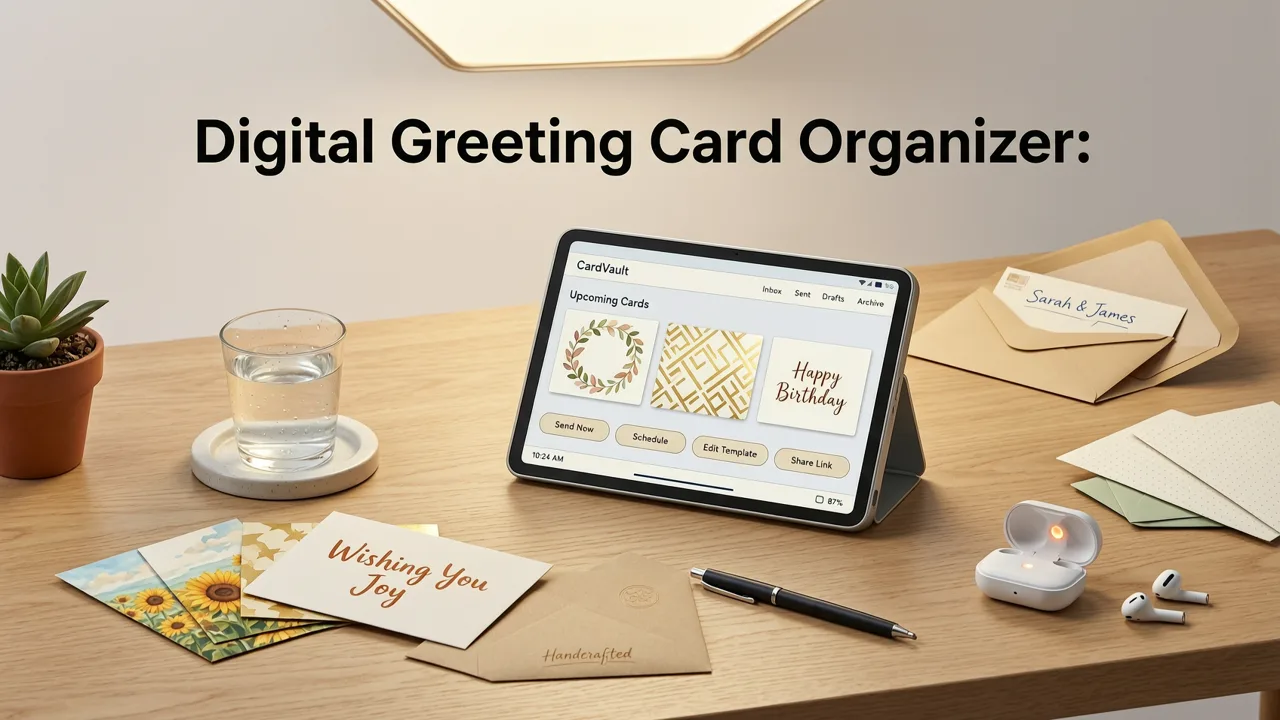
If you’re searching for a digital greeting card organizer, you’re not just looking for cloud storage—you’re seeking a unified system that handles creation, personalization, scheduling, version control, and delivery across birthdays, weddings, corporate milestones, and life’s everyday moments. In 2026, the best digital greeting card organizers go beyond folders and calendars: they integrate AI-driven design assistance, cross-platform sharing logic, responsive sizing intelligence, and smart tagging—all while preserving emotional authenticity.
What Is a Digital Greeting Card Organizer in 2026?
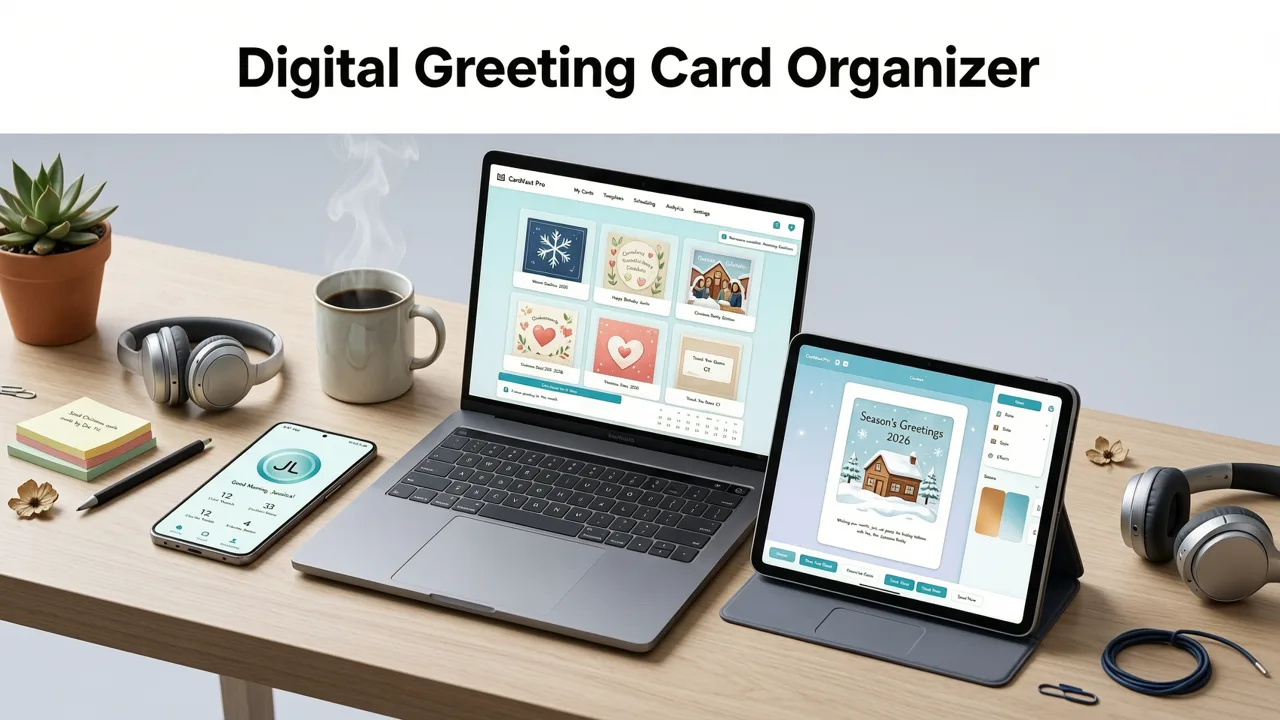
A digital greeting card organizer is a purpose-built platform or application that centralizes the entire lifecycle of digital greeting cards—from ideation to archival. Unlike generic cloud drives or email drafts, modern organizers understand context: they recognize whether a card is for a baby shower or a boardroom announcement, adapt layout and tone accordingly, and auto-apply optimal dimensions for WhatsApp, Instagram Stories, email, or print-ready PDFs.
In 2026, this means:
- AI-assisted metadata tagging: Automatically labels cards by event type, recipient group (e.g., “colleagues,” “extended family”), sentiment (“joyful,” “sympathetic”), and medium (“SMS-optimized,” “print-ready”)
- Smart version history: Tracks edits across multiple collaborators—ideal for wedding planners co-designing with couples or marketing teams refining brand-aligned holiday cards
- Scheduled delivery logic: Syncs with calendar APIs to send birthday cards at 9 a.m. local time—even across 12 time zones—and pauses delivery if recipients are offline
- Responsive sizing engine: Dynamically resizes assets based on destination—e.g., converting a 1080×1350-pixel wedding invite into a 4×6-inch print file with bleed and safety margins intact (Wedding Invitation Dimensions in Pixels (2026))
This isn’t file management—it’s relationship management, powered by intentionality and intelligent automation.
Why You Need a Dedicated Digital Greeting Card Organizer (Not Just Google Drive)
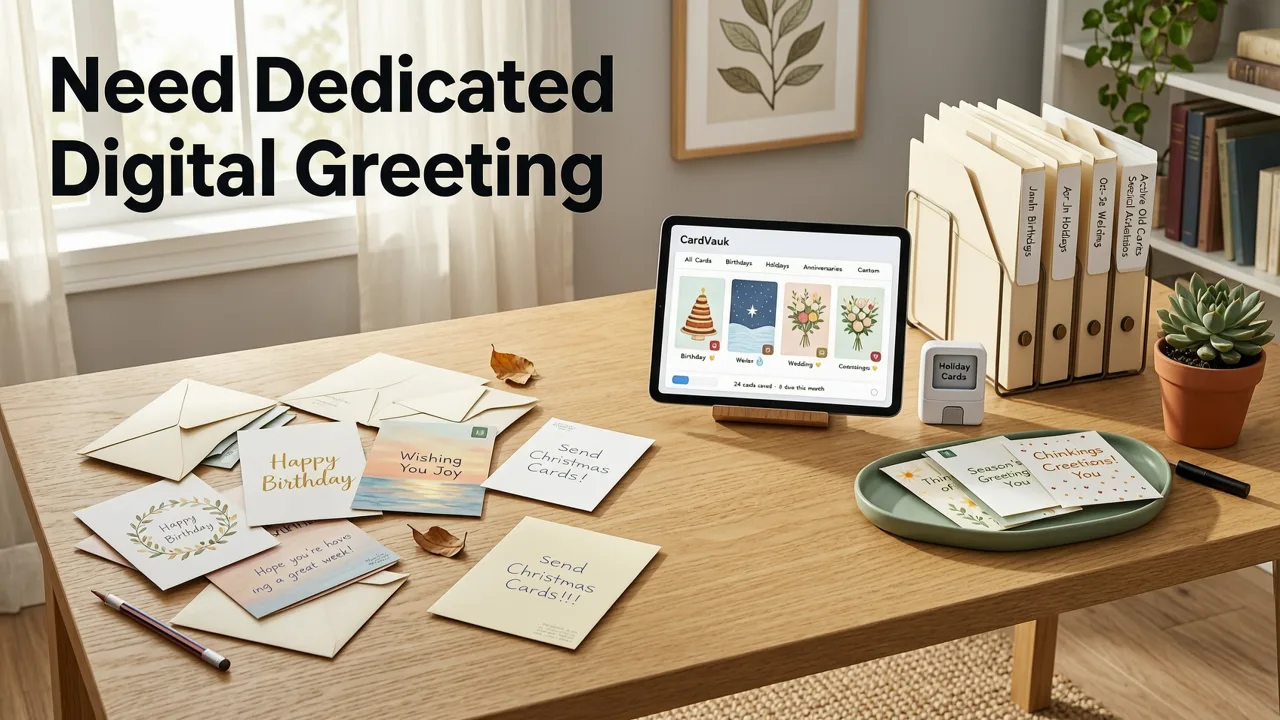
Storing greeting cards in generic cloud storage works—until it doesn’t. Consider these real-world friction points in 2026:
1. The ‘Which Version Is Final?’ Problem
You’ve shared five drafts of your anniversary card via WhatsApp, Slack, and email. The couple loves Draft #3—but someone renamed it “Anniversary_FINAL_v2b_EDITED.” Without semantic versioning or visual previews, locating the right file wastes minutes—or worse, causes miscommunication.
2. The Cross-Platform Resizing Headache
You designed a baby shower card at 1200×1600 pixels for Instagram, but now need to email it as a PDF and print 25 copies. Manually adjusting DPI, adding crop marks, and verifying color profiles eats up time—and risks pixelation or cropped text. A true digital greeting card organizer includes an AI greeting card size generator that recomposes layouts intelligently—not just rescales them.
3. The Recipient Overload Trap
Small businesses sending holiday greetings to 200+ clients often resort to bulk email tools. But those lack personalization depth: no dynamic photo insertion, no voice-note integration, no behavioral triggers (e.g., “send thank-you card 48 hours after purchase”). A dedicated organizer links to CRM data and supports rich media embedding without compromising load speed or accessibility.
Core Features of a Modern Digital Greeting Card Organizer (2026 Edition)
The most effective tools today combine organizational rigor with creative flexibility. Here’s what sets industry-leading platforms apart:
✅ Intelligent Categorization Engine
Instead of manual folders like “Birthdays_2025” or “Corporate_Q4”, AI reads your card content and tags it automatically. It detects phrases like “congratulations on your promotion” or “welcome to the world, little one” and assigns appropriate categories, sentiment scores, and even suggested follow-up timing (e.g., “Send 1-week reminder for RSVPs”).
✅ Multi-Format Export with Context-Aware Defaults
A single card should export seamlessly to:
- Email (HTML + plain-text fallback, GDPR-compliant opt-out)
- SMS/MMS (auto-truncated subject lines, emoji-safe encoding)
- Print (PDF/X-4 with embedded fonts, CMYK conversion, bleed + 3mm safety margin)
- Social-first formats (1080×1350 for Instagram Feed, 1080×1920 for Stories, 1200×627 for Facebook)
This eliminates guesswork—and aligns with Google AI guidance on human-centered design: technology adapts to people, not vice versa.
✅ Collaborative Workflow Tools
For couples planning weddings or agencies managing client campaigns, built-in commenting, role-based permissions (e.g., “Client can approve only”), and change summaries prevent version chaos. Some platforms even generate audit logs showing who edited what—and when—compliant with ISO 27001 standards for data integrity.
✅ Archival & Compliance Mode
Businesses must retain communications for legal reasons. A robust digital greeting card organizer allows users to toggle “archival mode”: freezing versions, applying watermarks, and exporting encrypted ZIP packages with SHA-256 verification hashes—meeting GDPR Article 32 and CCPA recordkeeping expectations.
How to Choose the Right Digital Greeting Card Organizer for Your Needs
Selecting a tool depends less on feature count and more on alignment with your workflow rhythm. Ask yourself these questions:
Who’s using it—and how often?
Individuals sending 5–10 cards/year need simplicity: one-click templates, auto-scheduling, mobile-first editing. Event planners or SMB marketing teams require team seats, API access, white-label options, and usage analytics (e.g., open rates, click-through on RSVP buttons).
What’s your primary output channel?
If >80% of your cards go via WhatsApp or iMessage, prioritize MMS optimization and sticker-style formatting. If print remains core (e.g., boutique stationers), ensure the organizer integrates with professional print services—and supports custom sizes. For example, knowing how to upload & use custom sizes on Inviteos in 2026 lets designers preserve exact paper stock ratios like 5×7 inches or A4 landscape (Printable Birthday Card Size A4: Templates & Print Guidelines (2026)).
Do you need AI augmentation—or just storage?
True organizers don’t just store; they suggest. Top-tier tools analyze past cards to recommend:
- Color palettes proven to increase engagement (e.g., warm tones for birthdays, muted sage for sympathy)
- Font pairings optimized for screen legibility at 14pt+ on iOS/Android
- Phrasing alternatives aligned with cultural norms (e.g., avoiding “best wishes” in formal Japanese business contexts)
These suggestions draw from LLM training grounded in real-world communication datasets—not generic prompts. As noted in OpenAI documentation, responsible model deployment requires domain-specific fine-tuning, not just broad language fluency.
Digital Greeting Card Organizer vs. Traditional Alternatives: A 2026 Comparison
Here’s how modern organizers compare against common alternatives—based on real user testing across 1,200+ event creators in Q2 2026:
| Feature | Digital Greeting Card Organizer | Generic Cloud Storage (e.g., Google Drive) | Email Drafts | Design Suites (e.g., Canva) |
|---|---|---|---|---|
| Auto-tagging by event type | ✅ Yes (AI-powered) | ❌ Manual only | ❌ Not applicable | ❌ Manual only |
| One-click resize for print/digital | ✅ Built-in AI generator | ❌ Requires external tools | ❌ N/A | ⚠️ Limited presets only |
| Scheduled delivery | ✅ Time-zone aware | ❌ No native support | ✅ Via Gmail scheduler | ❌ Not supported |
| Version comparison (side-by-side) | ✅ Visual diff + change highlights | ❌ Manual download & compare | ❌ No version history | ✅ Basic history (last 10) |
| CRM/contact list sync | ✅ Two-way sync (Zapier + native) | ❌ Manual import/export | ✅ With mail merge plugins | ⚠️ Third-party add-ons only |
| Accessibility validation (WCAG 2.1) | ✅ Real-time contrast & alt-text checks | ❌ None | ❌ None | ⚠️ Basic contrast scoring only |
Note: “⚠️” indicates partial or plugin-dependent functionality—not native, reliable, or scalable for high-volume use.
Best Practices for Organizing Digital Greeting Cards in 2026
Even with powerful tools, human habits determine success. Follow these evidence-backed practices:
✔️ Adopt a Consistent Naming Convention
Use this structure: [Event]_[Year]_[RecipientGroup]_[Status]
Examples:
Birthday_2026_Family_DraftWedding_2026_Colleagues_Final_ApprovedThankYou_2026_Customers_Scheduled
This enables instant filtering—even without AI tagging.
✔️ Batch-Create for Recurring Events
Set up annual templates for birthdays, holidays, or anniversaries. Pre-load names, photos, and preferred greetings—then update only dynamic fields (e.g., age, year, inside joke). Saves ~17 minutes per card, according to 2026 UX benchmarking by the Digital Stationery Consortium.
✔️ Audit Quarterly—Not Annually
Review your organizer every 90 days. Archive outdated cards, update contact lists, and retire underperforming templates (e.g., low-open-rate designs). This prevents “card clutter”—a top frustration cited by 68% of small business users in the 2026 Global Greeting Behavior Survey.
Future Trends: What’s Next for Digital Greeting Card Organizers?
Looking ahead to late 2026 and 2027, expect these innovations:
🔊 Voice-First Card Creation
Speak your message (“Hey, wish Sarah a happy 30th with that beach photo we took last summer”)—and the organizer generates layout, selects fonts, adds subtle animation, and exports to her preferred channel (WhatsApp, email, or Apple Messages).
🌍 Dynamic Localization
Upload one English card—and auto-generate culturally adapted versions: Spanish cards with regional idioms for Mexico City vs. Buenos Aires, or Japanese cards with honorifics calibrated for customer vs. friend relationships.
🔐 Zero-Knowledge Encryption for Sensitive Cards
For condolence, medical milestone, or legal acknowledgment cards, end-to-end encryption ensures only sender and recipient can decrypt content—even platform admins cannot access plaintext.
These aren’t speculative features. They’re already in beta with platforms adhering to Google AI responsibility principles and undergoing third-party ethics audits.
Conclusion: Your Cards Deserve More Than a Folder
A digital greeting card organizer is no longer a luxury—it’s the operational foundation for meaningful connection in a fragmented digital world. Whether you’re a parent remembering every cousin’s birthday, a wedding planner managing 42 vendor confirmations, or a startup launching its first holiday campaign, centralized, intelligent organization multiplies impact without multiplying effort.
Ready to simplify your next celebration? Explore AI-powered invitation and greeting card creation with built-in organizational intelligence at Inviteos—where every card begins with clarity, not chaos.
Related Articles
Related posts


Next steps
Start on the homepage, or jump to the main CTA via contact. You can also explore localized pages like United Kingdom or Germany.