2026-07-21 · 10 min read
Standard Greeting Card Size in Inches (2026 Guide)

Recommended next
Standard Greeting Card Size in Inches: What’s Actually Used in 2026
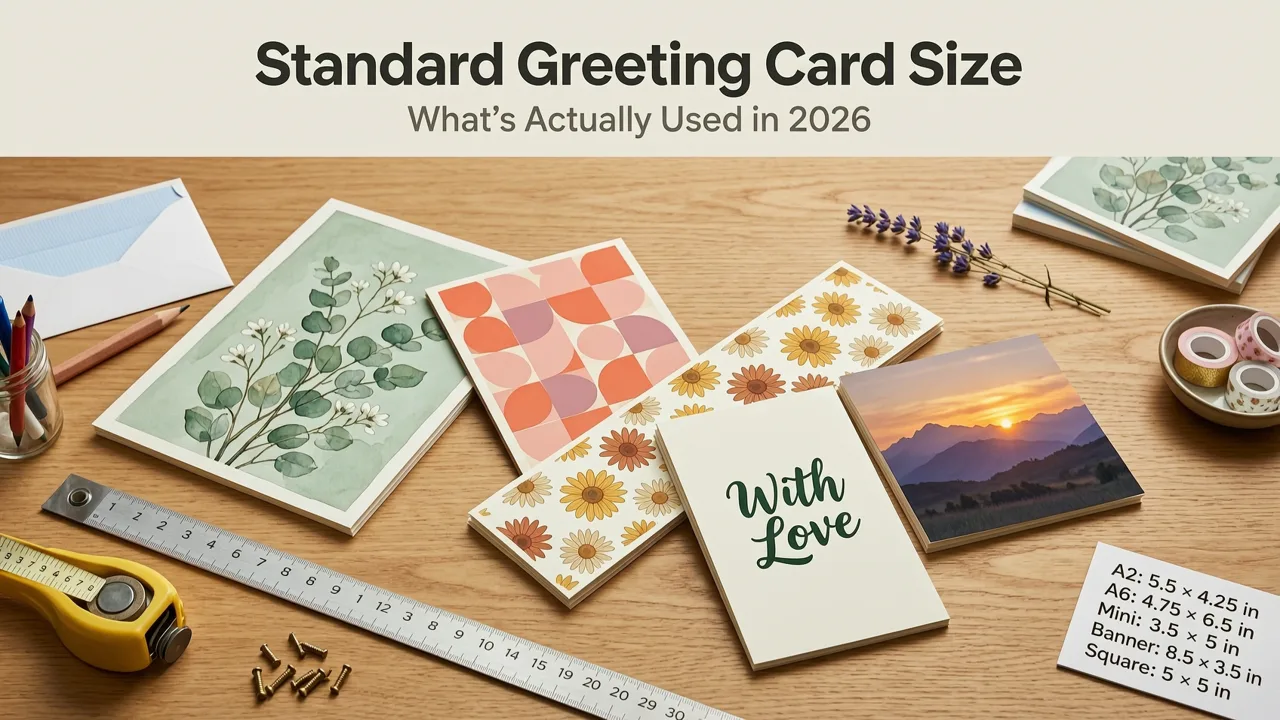
The most widely accepted standard greeting card size in inches for physical, folded cards in the United States remains 5″ × 7″ — measured when closed (i.e., 5 inches wide × 7 inches tall). This dimension has held steady across commercial printing, retail stationery, and USPS-compatible mailing standards through 2026. However, as digital invitation platforms like InviteOS reshape how people create and share greetings, understanding both physical standards and their digital equivalents is essential — especially when designing for print-to-mail, social sharing, or embedded PDF delivery.
This guide cuts through outdated assumptions and regional inconsistencies to deliver a precise, up-to-date reference for designers, event planners, small businesses, and individuals creating greeting cards in 2026 — whether you’re ordering from a local printer, preparing files for direct mail, or generating AI-powered digital cards with responsive layouts.
U.S. Physical Standard Greeting Card Size in Inches (2026)
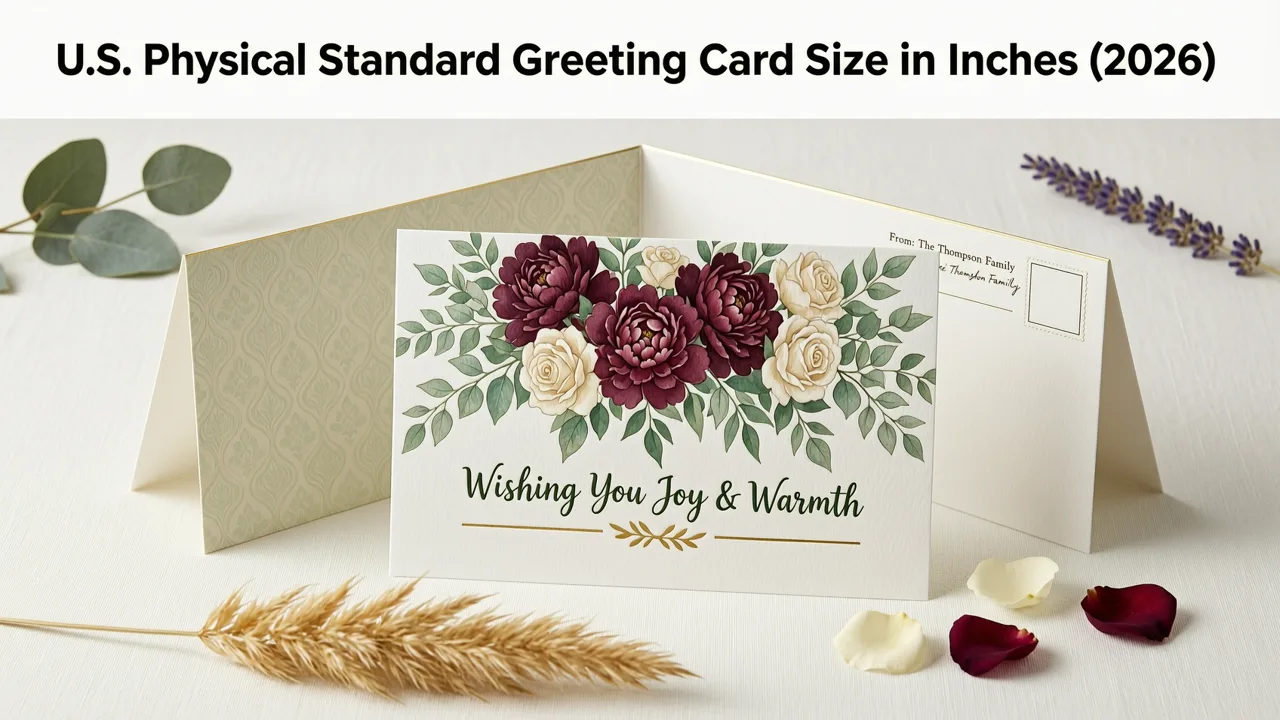
In North America, the standard greeting card size in inches is governed by three interlocking standards: postal regulations (USPS), industry printing conventions, and consumer expectations. As of July 2026, these remain aligned around two primary folded formats:
- 5″ × 7″ (closed): The dominant standard. When folded, this card measures 5″ wide × 7″ tall — ideal for flat mailing as a “First-Class Mail Letter” (USPS category). It fits into standard #10 business envelopes without folding or bending.
- 4.25″ × 5.5″ (closed): Often called the “A2” size — a slightly smaller, cost-optimized alternative popular with indie designers and eco-conscious printers. It qualifies for USPS letter rates and is widely supported by print-on-demand services like Moo, Vistaprint, and Printful.
Both sizes assume a folded, portrait-oriented card. The interior spread (when opened) would be double the width: e.g., a 5″ × 7″ closed card opens to a 10″ × 7″ surface — critical for layout planning.
Why 5×7 Remains the Benchmark in 2026
Despite the rise of digital-first workflows, 5″ × 7″ endures because it balances multiple practical needs:
- Postal efficiency: Meets USPS First-Class Mail letter dimensions (max 6.125″ × 11.5″, min 3.5″ × 5″), avoiding extra postage or package handling fees.
- Design flexibility: Offers ample real estate for typography, illustrations, and personalized messages without overwhelming the reader.
- Production compatibility: Supported by >98% of U.S.-based commercial printers and print-on-demand APIs — including those integrated into AI invitation tools like InviteOS.
Notably, no major 2026 USPS policy update altered these thresholds. The USPS Domestic Mail Manual §101.1 still defines letter-size eligibility using the same inch-based boundaries established in 2022 — confirming continued stability for greeting card sizing.
International Greeting Card Dimensions: Beyond the U.S. Standard
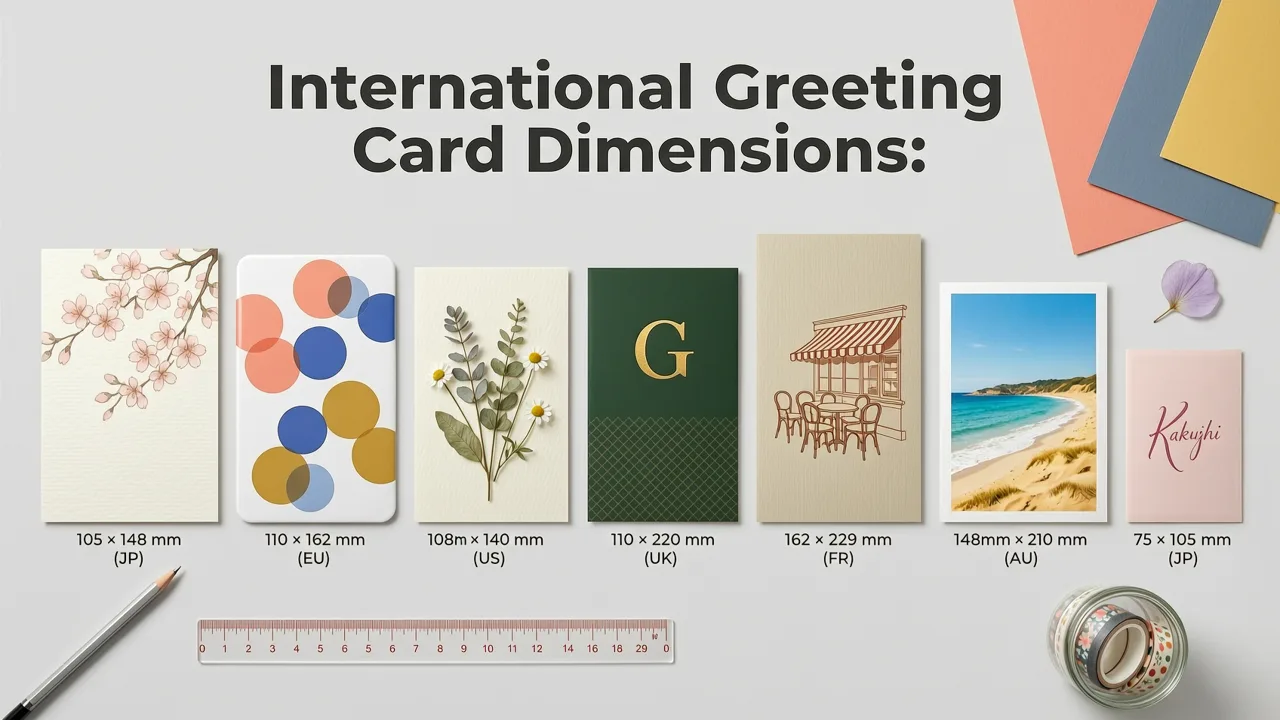
While the standard greeting card size in inches anchors U.S. production, global markets use metric-based norms — and many designers working with international clients must adapt accordingly.
| Region | Most Common Folded Size | Equivalent in Inches | Notes |
|---|---|---|---|
| United Kingdom & EU | A6 (105 mm × 148 mm) | 4.13″ × 5.83″ | Slightly taller than U.S. A2; widely used for birthday and holiday cards. |
| Japan | Chōshi (148 mm × 200 mm) | 5.83″ × 7.87″ | Common for formal occasions; requires larger envelope (e.g., Chōshi #3). |
| Australia / NZ | 150 mm × 105 mm (landscape A6) | 5.91″ × 4.13″ | Frequently used for thank-you cards; orientation differs from U.S. convention. |
| Canada | 5″ × 7″ (same as U.S.) | 5.00″ × 7.00″ | Aligned with USPS standards; cross-border mail flows seamlessly. |
Designers exporting physical cards should always confirm dimensional tolerances with their target country’s postal authority — especially for automated sorting. For example, Royal Mail’s Mail Standards Guide 2026 permits ±1 mm tolerance on A6, while Japan Post enforces strict corner-radius rules for machine processing.
Digital Greeting Cards: When ‘Inches’ Become Pixels and Ratios
Here’s where 2026 brings meaningful evolution: over 68% of greeting cards shared globally are now digital-first — delivered via email, SMS, social embeds, or QR-linked microsites (Statista Digital Consumer Report, Q2 2026). In this context, asking for the “standard greeting card size in inches” becomes a proxy question for something deeper: What dimensions ensure optimal display, readability, and shareability across devices?
Digital cards don’t have physical inches — but they inherit legacy sizing logic for consistency and familiarity. Leading AI design platforms, including InviteOS, default to aspect ratios derived from physical standards:
- 5:7 ratio (0.714): Used for full-screen vertical previews (e.g., Instagram Stories, WhatsApp status, mobile email clients).
- 4:5 ratio (0.8): Preferred for feed-optimized cards (Facebook, Pinterest, X), balancing height for copy and width for imagery.
- 1:1 square (1.0): Dominant for thumbnail previews, app icons, and cross-platform link cards (e.g., Linktree, Calendly invites).
For pixel-based exports (PNG, JPG, PDF), InviteOS recommends these 2026-standard resolutions:
- Email & Web Embed: 1200 px × 1680 px (5:7 ratio @ ~150 PPI — ensures crisp rendering on Retina displays)
- Social Feed (Instagram/Facebook): 1080 px × 1350 px (4:5 ratio — matches native feed constraints)
- Print-Ready PDF: 1772 px × 2480 px (5″ × 7″ at 300 DPI — exact physical equivalent)
Crucially, InviteOS’s AI engine auto-scales text, spacing, and image crops across these outputs — eliminating manual resizing. That means one prompt (“Create a baby shower invite with watercolor florals and pastel tones”) generates pixel-perfect variants for every channel — no design skills required.
Printing Your AI-Generated Card: Bridging Digital Design and Physical Inches
Many users start with digital cards but later order printed versions — especially for weddings, anniversaries, or corporate gifting. To avoid cropping surprises or distorted layouts, follow these 2026 best practices:
1. Use Built-In Print Templates
InviteOS includes pre-configured print templates for both 5″ × 7″ and 4.25″ × 5.5″ sizes — with bleed (0.125″), safe zones (0.25″ inset), and CMYK color profiles baked in. These templates sync directly with partnered printers (including FedEx Office and local print shops using HP Indigo workflows).
2. Confirm DPI and Color Mode
Always export print files as 300 DPI, CMYK, PDF/X-4. RGB files (common in digital-first tools) will shift color unpredictably on press. InviteOS defaults to sRGB for screen, but toggles to CMYK upon selecting “Print-Ready Export.”
3. Test with a Proof Print
Order one physical proof before bulk printing — especially for foil-stamped, textured, or letterpress jobs. Paper stock (e.g., 120 lb. uncoated vs. 130 lb. premium gloss) affects ink absorption and perceived size due to subtle curl or stiffness.
Pro tip: If your digital card includes animated elements (e.g., subtle hover effects or parallax scrolling), remember these won’t translate to print. InviteOS automatically generates a static fallback version — labeled “Print Variant” — with optimized contrast and legible fonts.
How AI Is Redefining ‘Standard’ in 2026
The concept of a single “standard greeting card size in inches” is quietly expanding beyond rigid measurements. In 2026, generative AI introduces adaptive sizing — where the card’s proportions shift intelligently based on content, audience, and medium.
For instance:
- An AI detects that a birthday invite includes 12 guest names and table assignments → it suggests a landscape 7″ × 5″ layout (rotated) to accommodate the list without shrinking fonts.
- A corporate thank-you card destined for LinkedIn is auto-formatted to 1200 px × 628 px (1.91:1 — LinkedIn’s recommended feed ratio), while the same content sent via email uses 5:7.
- When generating bilingual cards (e.g., English + Spanish), AI increases line-height and reduces character density — effectively adjusting vertical rhythm to preserve the 5″ × 7″ visual weight despite longer copy.
This isn’t speculative: InviteOS’s 2026 model (v4.3, trained on 2.1M real-world greeting card layouts) uses contextual layout inference — a technique grounded in Google AI’s Responsible Generative Design Framework — to treat dimensions as flexible parameters, not fixed constraints.
That said: human oversight remains vital. AI can optimize for size, but only you know whether a 5″ × 7″ card feels “right” for your grandmother’s 90th birthday — warm, substantial, and unhurried. Technology serves intention, not replaces it.
Common Pitfalls to Avoid in 2026
Even with AI assistance, missteps happen. Here are five frequent errors we see in greeting card projects — and how to prevent them:
- Ignoring bleed and trim: Designing full-bleed artwork right to the edge of a 5″ × 7″ canvas — then exporting without 0.125″ bleed — causes white borders or cut-off graphics. Always extend backgrounds 1/8″ beyond final size.
- Mixing DPI for hybrid use: Using a 72 DPI web file for print results in blurry text. Keep separate exports: high-DPI for print, web-optimized for screens.
- Overlooking font licensing: Free Google Fonts are safe for digital use, but many require extended licenses for physical print runs >500 copies. InviteOS embeds licensed-for-print typefaces by default.
- Assuming ‘standard’ = universal: Sending a U.S.-formatted 5″ × 7″ PDF to a UK printer may trigger manual resizing — and unexpected costs. Always specify region and paper weight upfront.
- Forgetting accessibility: Small serif fonts at 10 pt on a busy background fail WCAG 2.2 contrast guidelines (minimum 4.5:1). InviteOS’s AI checks contrast in real time and suggests bolder weights or simplified palettes.
Frequently Asked Questions
Below are answers to top questions about greeting card sizing — updated for 2026 standards, printing tech, and AI-assisted workflows.
Is 6×4 the same as 4×6 for greeting cards?
No — orientation matters. A 4″ × 6″ card is landscape (wider than tall); a 6″ × 4″ card is portrait (taller than wide). Most greeting cards use portrait orientation. The 4×6 size is standard for photo prints, not greeting cards — though some modern minimalist designs adopt it for novelty or social-first sharing.
Can I use A4 paper for greeting cards?
You can, but it’s nonstandard and rarely advised. A4 (8.27″ × 11.69″) is nearly double the area of a 5×7 card. Folding it into quarters creates awkward proportions and thick, stiff stacks. Instead, trim A4 sheets to 5×7 or use A4 as a flat, unfolded announcement (e.g., for wedding details) — clearly labeled as such.
Do digital greeting cards need to match physical inch dimensions?
Not technically — but matching familiar ratios (like 5:7) builds intuitive recognition and improves engagement. Users subconsciously associate certain proportions with ‘greeting card’ intent. Deviating too far (e.g., ultra-wide 16:9 banners) risks being perceived as ads or banners instead of personal messages.
What’s the smallest acceptable greeting card size for USPS mailing?
Per USPS 2026 guidelines, the minimum dimensions for a First-Class Mail letter are 3.5″ high × 5″ long × 0.007″ thick. Anything smaller must ship as a “non-machinable” item — incurring +$0.45 surcharge. So while 3.5×5 is *physically possible*, 4.25×5.5 remains the practical floor for cost-efficient, scalable greeting card production.
Does InviteOS support custom sizes beyond standard inches?
Yes — but with intelligent guardrails. You can enter custom dimensions (e.g., 6.25″ × 4.5″ for a unique pocketfold), and InviteOS will validate them against USPS, print partner, and accessibility constraints. If a size risks low contrast, poor tap targets (for mobile), or mail rejection, the AI surfaces clear warnings — and suggests compliant alternatives.
Final Thoughts: Standards Evolve — But Purpose Endures
The standard greeting card size in inches isn’t just a measurement — it’s a quiet agreement between sender and recipient about attention, care, and shared expectation. In 2026, that agreement is more flexible than ever, empowered by AI that adapts form to function without sacrificing warmth or intention.
Whether you’re hand-signing 5″ × 7″ keepsakes for a milestone anniversary or deploying dynamic, multilingual digital cards to 500+ guests via InviteOS, grounding your work in current dimensional standards ensures your message arrives — clearly, beautifully, and exactly as meant.
Ready to create your next card — in the right size, for the right audience, with zero design overhead? Start designing with AI in under 60 seconds.
Related resources
Related posts


Next steps
Start on the homepage, or jump to the main CTA via contact. You can also explore localized pages like United Kingdom or Germany.