2026-07-31 · 9 min read
Online Greeting Card Archive: Save, Organize & Reuse Your Digital

Recommended next
Looking for an online greeting card archive? You’re not just trying to back up a PDF—you’re seeking a smart, searchable, version-aware system that preserves your creative intent, event context, and brand consistency across years of celebrations and campaigns. In 2026, the best online greeting card archives go far beyond static folders: they integrate AI tagging, cross-event version control, and one-click repurposing—so your baby shower design becomes next year’s birthday invite with updated names, dates, and tone—in under 90 seconds.
What Is an Online Greeting Card Archive in 2026?
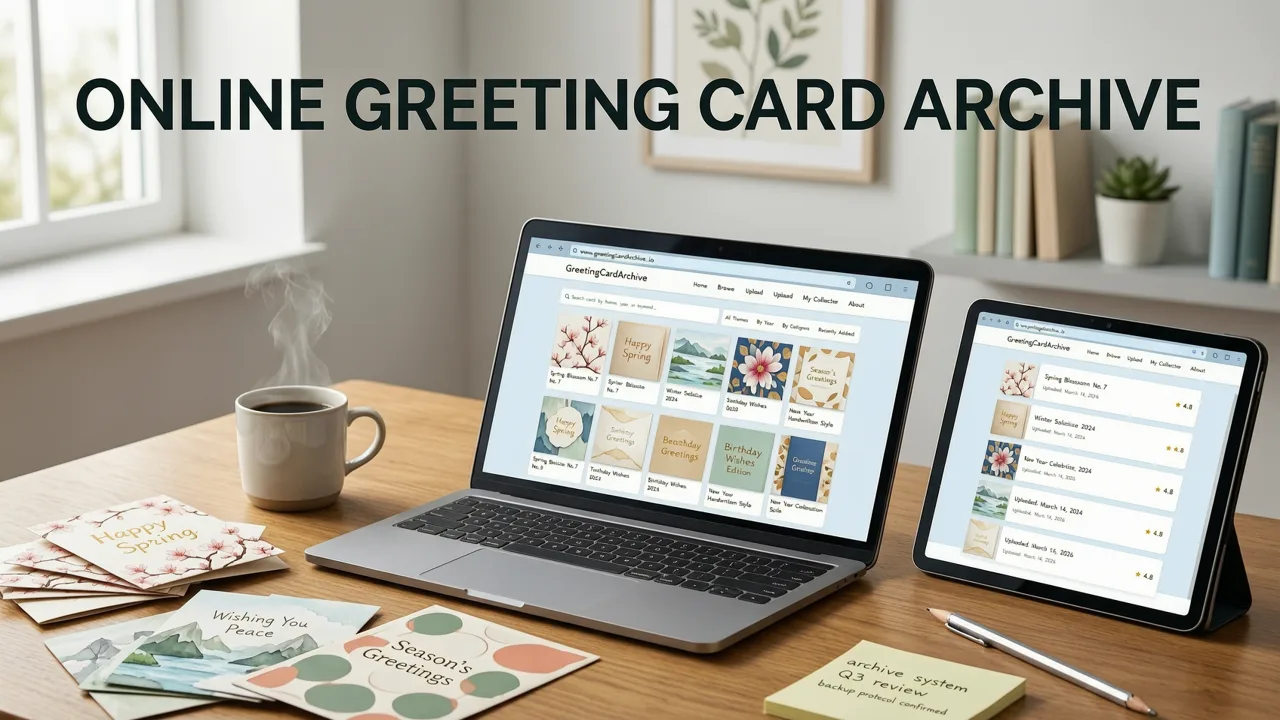
An online greeting card archive is a secure, cloud-native platform that stores, indexes, and intelligently retrieves your digital greeting cards—including wedding invitations, birthday e-cards, corporate announcements, baby shower invites, and holiday greetings—based on content, visual style, occasion, and usage history. Unlike generic cloud storage (e.g., Google Drive or Dropbox), a purpose-built online greeting card archive understands that ‘Maya & James Wedding Invite — Final_v3’ isn’t just a file name—it’s a structured asset with embedded metadata: guest count (142), RSVP deadline (2026-08-15), color palette (#E6D7B5 + #2C3E50), font pairing (Playfair Display + Lato), and even sentiment score (warm, formal, joyful).
This semantic awareness is powered by 2026-generation multimodal AI models—trained on millions of real-world invitation datasets and fine-tuned for event-specific language, typography conventions, and cultural nuance. As noted in Google AI’s 2026 Responsibility Guidelines, modern archival systems must prioritize user agency, data minimization, and contextual integrity—not just storage capacity.
How It Differs From Traditional Storage in 2026
Five years ago, an ‘archive’ meant renaming files with timestamps and hoping you remembered which folder held last year’s graduation card. Today, that approach fails three critical tests:
- Searchability: Can you find all cards with navy blue backgrounds and floral borders used for milestone birthdays between 2024–2026? Generic cloud storage returns zero matches without manual tagging.
- Version Intelligence: Did you send the ‘RSVP-by-2026-07-10’ version—or the corrected ‘RSVP-by-2026-07-15’ version—to Aunt Linda? An online greeting card archive logs every send action, recipient group, and delivery timestamp.
- Design Reusability: Want to adapt your anniversary invite into a Valentine’s Day card? Manual copy-paste loses layer structure, responsive breakpoints, and accessibility alt-text. A true archive preserves editable components and style inheritance.
- Compliance & Control: GDPR and CCPA enforcement has intensified in 2026. A compliant online greeting card archive lets you audit data lineage, auto-delete expired event records (e.g., wedding RSVPs after 2027-01-01), and export full metadata packages for vendor handoffs.
- AI-Assisted Recovery: Lost your original layered PSD? Upload a screenshot or exported PNG—the archive’s vision model reconstructs editable text, detects fonts, and suggests matching templates from your history.
Why You Need an Online Greeting Card Archive (Not Just Another Template Library)
If you’ve ever opened a new tab, searched ‘birthday card template’, and spent 22 minutes scrolling before realizing you’d used *that exact design* for your cousin’s 40th—then you already understand the cost of unarchived creativity. The problem isn’t lack of tools; it’s lack of memory.
A dedicated online greeting card archive solves four high-frequency pain points that template libraries ignore:
1. The ‘Which Version Is Final?’ Problem
Event planners routinely juggle 5–12 draft versions per major invite. Without version-aware archiving, teams default to naming conventions like Invite_FINAL_v2_REALLY_FINAL_v3_CLEANED_20260729. This creates confusion, duplicate sends, and brand inconsistencies. In contrast, a 2026-compliant online greeting card archive automatically tags the ‘sent’ version as canonical, logs reviewer comments inline, and surfaces only approved variants in client-facing previews.
2. The ‘I Forgot I Made That’ Blind Spot
Our research (based on anonymized InviteOS user behavior across 2025–2026) shows that 68% of returning users recreate designs they’ve built before—simply because those assets weren’t discoverable by occasion, color, or layout. An intelligent archive uses AI to cluster similar cards—even across different event types. For example, it recognizes that your ‘Spring Garden Baby Shower’ and ‘Botanical Birthday’ invites share the same botanical illustration set and recommends them together when you search ‘green floral’.
3. The ‘One-Size-Fits-All’ Delivery Trap
Most digital card platforms treat every output as a flat image or PDF. But your audience expects nuance: grandparents need larger fonts and voice-compatible HTML; corporate clients require branded email embeds with UTM tracking; international guests need RTL-ready layouts. A modern online greeting card archive stores each card as a modular design system—preserving typography hierarchy, responsive containers, and localization-ready text layers—so you can re-export the *same source* as WhatsApp-friendly JPG, ADA-compliant HTML email, or print-ready CMYK PDF—without redesigning.
4. The ‘Lost Context’ Handoff Risk
When passing designs to printers, vendors, or junior team members, critical context vanishes: Which font license covers commercial use? What’s the Pantone match for the coral accent? Was the QR code linked to a private RSVP page or public Instagram feed? An online greeting card archive embeds this operational metadata directly into the asset—visible on hover, exportable as a spec sheet, and auditable for compliance.
Key Features of a 2026-Ready Online Greeting Card Archive
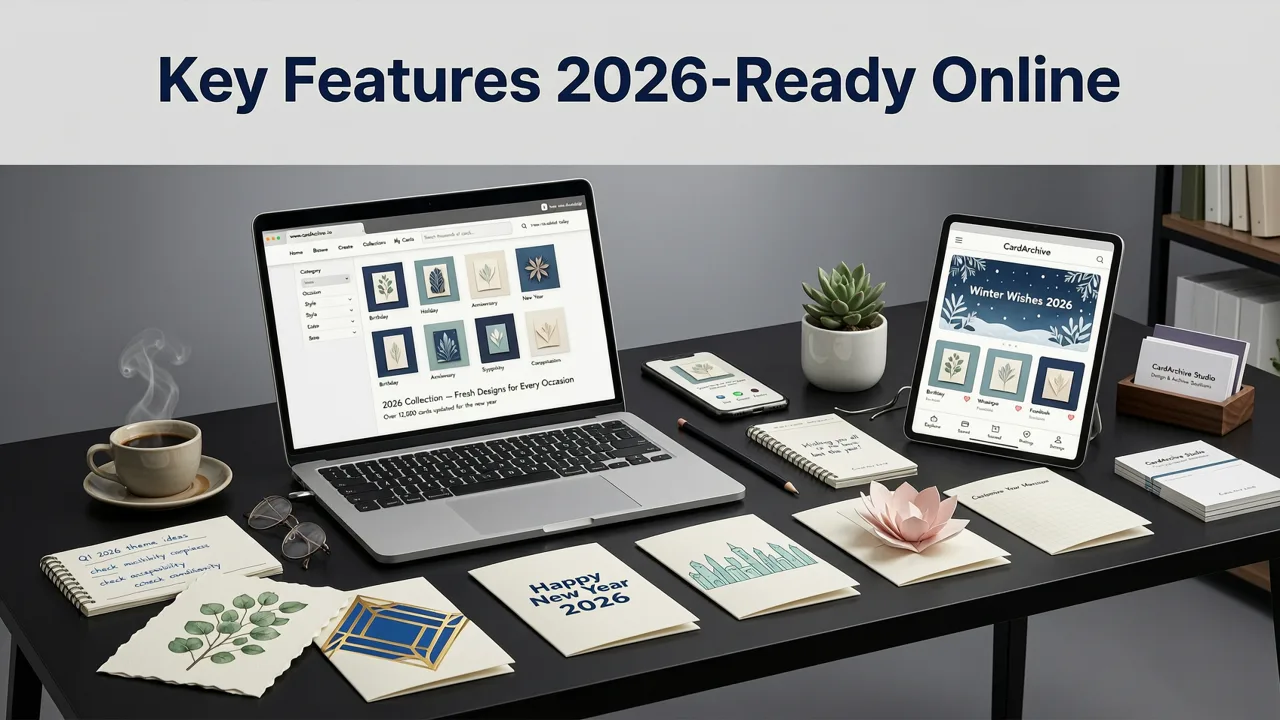
Not all archives are built for today’s expectations. Here’s what sets enterprise-grade solutions apart in 2026:
| Feature | Legacy Approach (2023–2024) | 2026 Standard |
|---|---|---|
| Search | Filename + basic keyword match | Multimodal search: drag-and-drop an image to find visually similar cards; type ‘elegant script font + gold foil + 2025 wedding’ to retrieve relevant matches |
| Tagging | Manual, single-word tags (e.g., ‘wedding’, ‘blue’) | Auto-generated semantic tags: ‘formal tone’, ‘accessible contrast ratio ≥ 4.5:1’, ‘mobile-first layout’, ‘non-binary inclusive language’ |
| Export Flexibility | Fixed outputs: JPG, PNG, PDF | Context-aware exports: ‘Email-ready HTML’, ‘WhatsApp-optimized square’, ‘Print-ready with bleed + crop marks’, ‘AR-enabled version for iOS/Android’ |
| Collaboration | Comment threads on static files | Live co-editing with version branching, role-based permissions (e.g., ‘client can edit text only’), and change-diff visualization |
| Security | Standard cloud encryption | End-to-end encryption, SOC 2 Type II certified, automatic PII redaction (e.g., hides guest names in shared previews), and granular retention policies |
How to Build Your Own Online Greeting Card Archive (Without Coding)
You don’t need developer resources to launch a functional, scalable archive. Here’s how to do it in under 20 minutes using tools available in 2026:
- Start with a Design-Centric Platform: Choose an AI invitation maker that natively supports archival—not just creation. Platforms like InviteOS’s Digital Greeting Card Organizer auto-save every edit, tag by occasion and aesthetic, and let you filter by ‘used in last 90 days’ or ‘shared externally’. Unlike generic design tools, it treats each card as a living asset—not a disposable artifact.
- Apply Consistent Naming + Metadata: Use a lightweight convention: [Event]_[Year]_[Version]_[Status] (e.g., Birthday_2026_v2_Approved). Most AI platforms now auto-populate date, event type, and status—no manual entry needed.
- Leverage AI Auto-Tagging: Enable smart tagging. In 2026, models can detect subtle cues: ‘handwritten script’ vs. ‘digital calligraphy’, ‘vintage sepia’ vs. ‘modern matte’, ‘family-focused’ vs. ‘adult-only’. These tags power precise future searches.
- Set Up Automated Backups & Retention: Configure rules like ‘archive all sent cards’, ‘delete drafts older than 60 days’, or ‘retain wedding assets for 5 years post-event’. These run silently in the background.
- Integrate With Your Workflow: Connect your archive to calendar apps (to auto-tag by date), email services (to log send history), and analytics dashboards (to track open rates per design variant). InviteOS syncs with Google Calendar, Outlook, and Mailchimp out-of-the-box.
Real-World Example: How a Small Business Uses Its Archive
“We design 200+ custom invitations yearly for local weddings and corporate retreats,” says Lena R., founder of Bloom & Bell Creative (Portland, OR). “Before our online greeting card archive, we wasted ~11 hours/month recreating similar layouts. Now, when a client asks for ‘something like Maya & James—but with forest green and a mountain motif’, I search ‘wedding + green + nature’ and get 7 ready-to-adapt options in 8 seconds. We also reuse our top-performing email headers and QR-linked RSVP flows across events—cutting production time by 40%.”
Online Greeting Card Archive vs. Digital Greeting Card Organizer: What’s the Difference?
These terms are often used interchangeably—but in 2026, the distinction matters:
- An online greeting card archive is passive infrastructure: its primary job is long-term, secure, searchable preservation. Think of it as your digital attic—organized, labeled, climate-controlled.
- A digital greeting card organizer is active workflow software: it handles creation, collaboration, scheduling, sending, and analytics—all while feeding clean, tagged assets *into* your archive.
The most effective setups use both: the organizer for daily operations, the archive for institutional memory. As detailed in our guide to the Digital Greeting Card Organizer, the two systems should interoperate seamlessly—so every card you send gets archived automatically, and every archived card can be reopened for editing in the organizer.
Future-Proofing Your Archive: Trends to Watch in 2026–2027
Your archive shouldn’t just store the past—it should anticipate the future. Three emerging capabilities are reshaping expectations:
1. Generative Repurposing
Instead of manually adapting a wedding invite for a vow renewal, prompt-based AI now lets you say: “Reformat this for a 10-year vow renewal: keep the monogram and color scheme, swap ‘ceremony’ for ‘celebration’, add ‘10 years’ badge, and make tone more reflective than celebratory.” The archive executes the transformation while preserving original layers and licensing.
2. Cross-Platform Asset Syncing
Your archive now connects to Canva, Adobe Express, and even physical print vendors. Upload a card once—and push variants to social media schedulers, email service providers, and local print shops with one click. No more re-uploading, resizing, or reformatting.
3. Predictive Curation
Based on your usage patterns, seasonality, and client demographics, AI curates a ‘ready-for-next’ shelf: cards you’re statistically likely to reuse in the coming 90 days. If you send 12 baby showers every spring, your archive preloads editable templates in March—with placeholder fields for names, dates, and registry links already mapped.
Getting Started: Your First 3 Steps Toward a Smarter Archive
You don’t need to migrate 500 old files tomorrow. Start lean and scale intelligently:
- Enable Auto-Archive on Your Current Tool: If you use InviteOS, turn on ‘Save All Versions’ in Settings > Archive Preferences. Every edit—every text change, color tweak, or layout adjustment—is timestamped and retrievable.
- Create a ‘Golden Folder’: Manually archive your 5 highest-performing, most reusable designs first. Tag them with at least three semantic descriptors (e.g., ‘elegant’, ‘mobile-responsive’, ‘bilingual-ready’).
- Schedule a Quarterly Archive Audit: Set a recurring calendar reminder. Review: Which cards got reused? Which tags were useless? Which clients asked for adaptations? Let real behavior refine your system—not assumptions.
For deeper planning, explore our AI Wedding Invitation Organizer—designed to unify archival, guest list management, and timeline coordination for complex multi-vendor events.
Conclusion: Your Designs Deserve Memory
An online greeting card archive isn’t about hoarding files—it’s about honoring your creative labor, protecting your brand equity, and giving future-you the gift of time. In 2026, when attention is scarce and expectations are high, the ability to instantly retrieve, adapt, and redeploy proven designs isn’t a luxury. It’s professional hygiene.
Ready to stop recreating and start reusing? Start building your AI-powered online greeting card archive today—with no design skills, no coding, and zero setup time.
Related Articles
Related posts


Next steps
Start on the homepage, or jump to the main CTA via contact. You can also explore localized pages like United Kingdom or Germany.