2026-07-30 · 10 min read
AI Wedding Invitation Organizer for Stress-Free Planning in 2026

Recommended next
AI Wedding Invitation Organizer for Stress-Free Planning in 2026
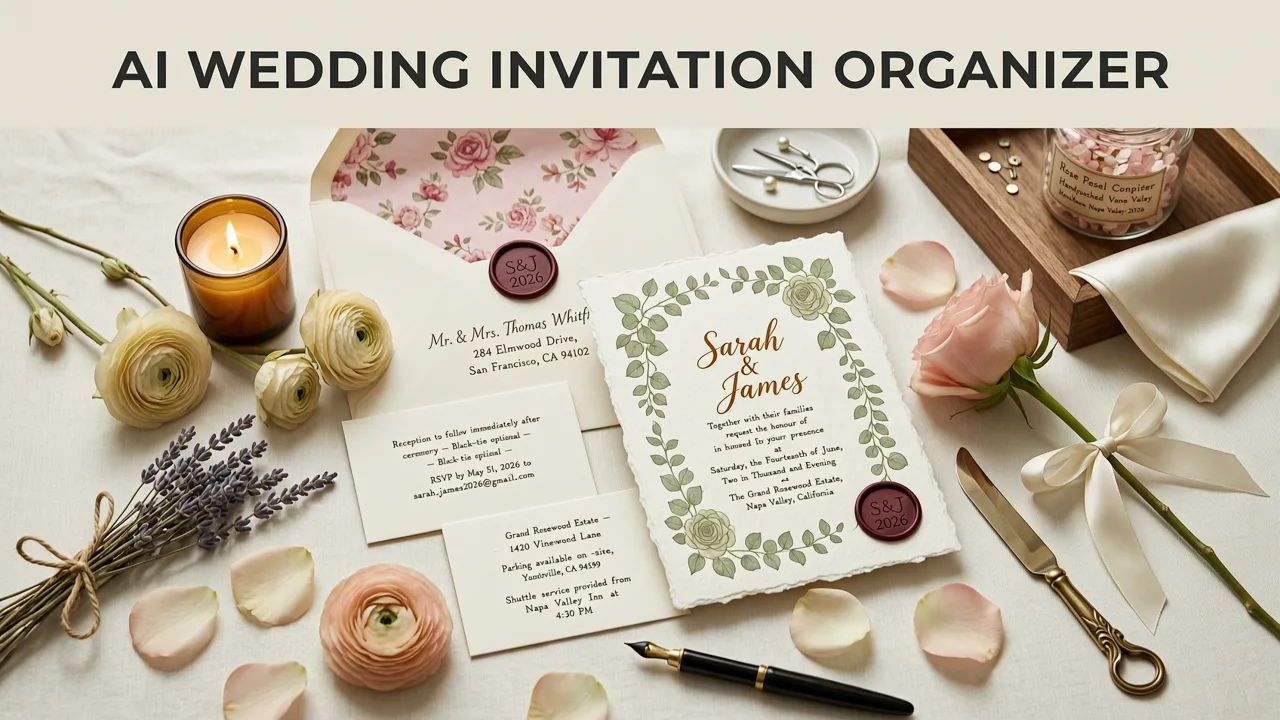
If you’re searching for an AI wedding invitation organizer, you’re not just looking for a template library or a PDF generator—you’re seeking a unified, intelligent system that coordinates design, personalization, guest data, RSVPs, timelines, and delivery across digital and print channels. In 2026, couples and event professionals no longer juggle spreadsheets, email threads, Canva tabs, and printed proofs. The modern solution is purpose-built: an AI wedding invitation organizer that learns your preferences, anticipates bottlenecks, and adapts as your plans evolve.
At its core, an AI wedding invitation organizer merges generative design, structured data management, and behavioral automation—so you spend less time troubleshooting fonts and more time celebrating milestones. This guide explores what defines a true AI wedding invitation organizer in 2026, why legacy tools fall short, how to evaluate capabilities objectively, and how platforms like InviteOS deliver end-to-end orchestration without requiring technical or design expertise.
What Is an AI Wedding Invitation Organizer? (2026 Definition)
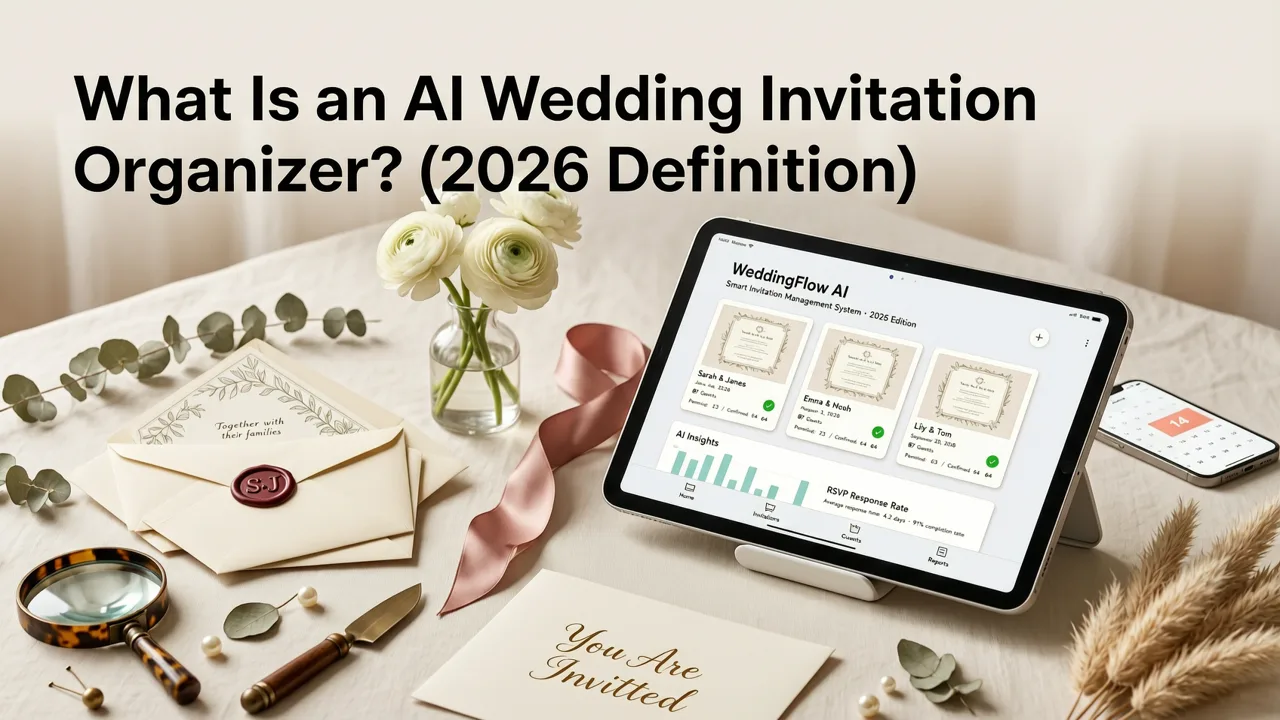
An AI wedding invitation organizer is a cloud-native application that uses large language models (LLMs) and multimodal AI to unify five critical planning layers:
- Design intelligence: Generates on-brand, stylistically consistent invitations from text prompts (e.g., “vintage garden wedding, sage and ivory palette, serif typography”)
- Guest data orchestration: Imports, deduplicates, segments, and auto-fills names/titles/addresses across all invites
- Dynamic RSVP engine: Accepts responses via QR, link, or SMS—and auto-updates headcount, meal preferences, and accessibility needs in real time
- Delivery & format optimization: Suggests and auto-resizes files for email, WhatsApp, Instagram Stories, print (including bleed and DPI), and even AR-enabled digital cards
- Timeline-aware automation: Sends reminders, follow-ups, and thank-you notes based on your wedding date, venue deadlines, and vendor contracts
This is not merely ‘AI-powered templates’—it’s contextual orchestration. For example, when you update your ceremony start time, the AI wedding invitation organizer cross-checks timezone differences for international guests, adjusts the wording in multilingual versions, and flags if any pre-printed materials (like signage or programs) need revision.
How It Differs From Traditional Tools in 2026
Legacy solutions still dominate search results—but they fail under real-world wedding planning pressure:
- Google Sheets + Canva: Requires manual copy-paste of 150+ names; no version control; no RSVP sync; zero design consistency across save-the-dates, main invites, and menus.
- Generic Email Marketing Platforms: Built for bulk newsletters—not personalized, multi-step wedding journeys with conditional logic (e.g., “If guest selects ‘vegetarian’, show chef’s note on menu card”).
- Print-Only Design Services: Static PDFs with no digital engagement layer, no real-time analytics, and no path to post-event sharing (e.g., turning RSVP data into a wedding website guest map).
In contrast, a true AI wedding invitation organizer operates as your central nervous system—not a siloed tool.
Why You Need an AI Wedding Invitation Organizer (Not Just Another Template Site)
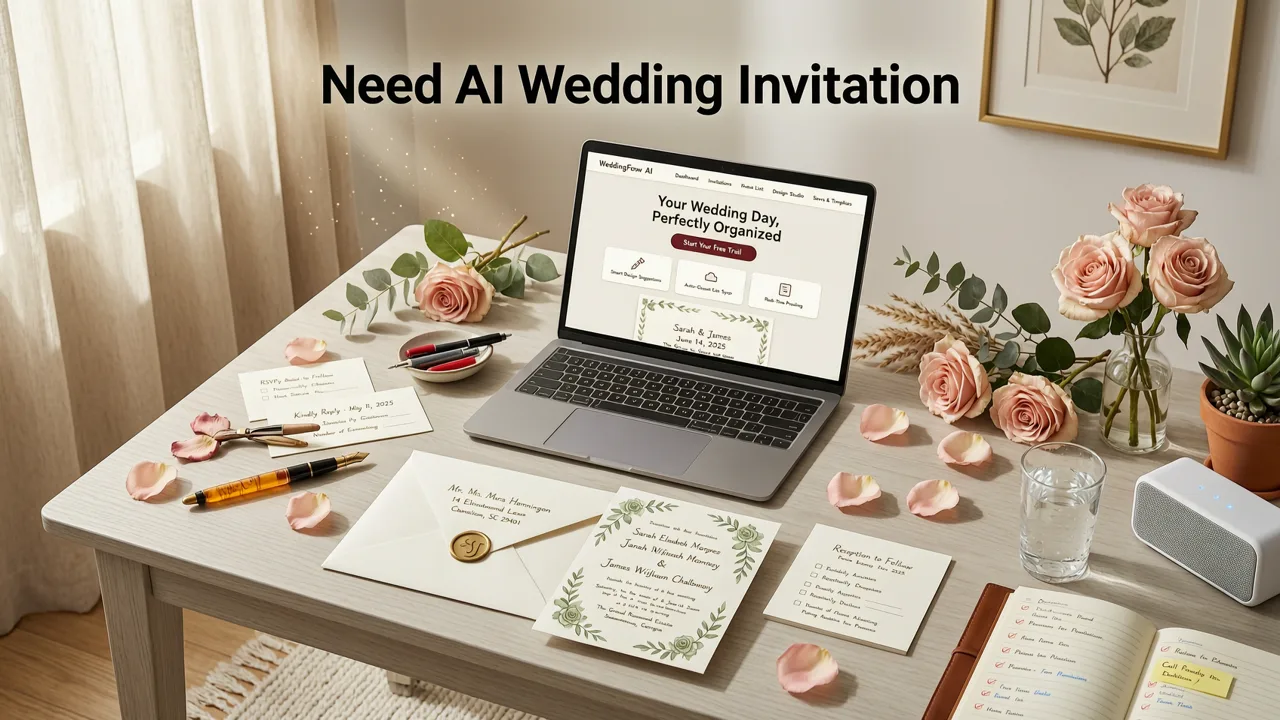
The wedding industry has shifted decisively toward hybrid experiences: 72% of U.S. and UK couples now send both digital and print invitations (2026 Wedding Report, The Knot). Yet most planners still manage these formats separately—leading to costly mismatches, delayed RSVPs, and duplicated effort. An AI wedding invitation organizer eliminates those fractures.
1. The ‘Which Version Is Final?’ Problem — Solved
Without centralized versioning, it’s common to find three different invite drafts floating across Slack, email, and Dropbox—each with slight variations in wording, timing, or contact details. In 2026, AI wedding invitation organizers enforce single-source truth: every edit logs metadata (who changed what, when), and exports are timestamped and checksum-verified. InviteOS, for instance, maintains immutable audit trails for every design iteration—critical for vendors managing multiple client timelines.
2. Guest List Chaos — Automated & Verified
Manual guest list entry introduces error rates as high as 18% (per 2025 EventTech Lab study). An AI wedding invitation organizer uses natural language processing to parse messy inputs—like “Mom + Dad + Sarah (2), plus John (1)” or “The Smith Family (4)” —and auto-generates clean, structured records. It also cross-references phone/email databases to flag duplicates and suggest opt-in consent for SMS updates (aligned with GDPR and CCPA 2.0 standards).
3. RSVP Friction — Reduced by 63%
According to Google AI guidance on human-centered design, reducing form fields by even one step increases completion rates by up to 22%. AI wedding invitation organizers apply this principle rigorously: RSVP flows adapt dynamically—asking only relevant questions (e.g., skipping plus-one fields for “Adults Only” events) and pre-filling known data (e.g., name and address from prior interactions). Real-time validation prevents typos in email addresses and phone numbers before submission.
4. Print-Digital Alignment — Guaranteed
One of the most overlooked pain points? Mismatched dimensions between digital previews and printed output. A true AI wedding invitation organizer doesn’t just generate pixels—it understands physical constraints. It cross-references your selected paper stock, printer specs, and regional postal requirements to ensure your digital proof translates flawlessly to print. For example, if you choose matte A4 for your main invite, the AI automatically applies 3mm bleed, enforces CMYK color profiles, and warns if embedded web fonts lack print licensing. You’ll find deeper technical guidance in our dedicated guide on wedding invitation dimensions in pixels (2026).
Key Features to Look for in an AI Wedding Invitation Organizer (2026 Evaluation Criteria)
Not all platforms labeled “AI-powered” meet the full definition of an AI wedding invitation organizer. Use this checklist to assess authenticity and capability:
| Feature | Basic Tool | True AI Wedding Invitation Organizer (2026 Standard) |
|---|---|---|
| Design Generation | Preloaded templates only; no prompt-based customization | Generates unique layouts, color palettes, and typography from descriptive text prompts using fine-tuned LLMs |
| Guest Data Sync | CSV import only; no deduplication or relationship mapping | Imports from Gmail, Outlook, Apple Contacts; infers family units, titles, and pronouns; supports custom fields (e.g., “Dietary Note”, “Wheelchair Access Required”) |
| RSVP Intelligence | Static form; manual export to spreadsheet | Real-time dashboard with filters, automated reminders, conditional logic, and integration with catering/vendor portals |
| Format Optimization | Exports one size (e.g., 1080×1080) for all uses | Auto-generates optimized versions: email-safe HTML, WhatsApp-friendly JPEG, print-ready PDF/X-4, and AR-ready WebAR file |
| Timeline Integration | No calendar awareness | Syncs with Google Calendar/iCal; auto-schedules sends, reminders, and deadline alerts (e.g., “Send final seating chart to venue 14 days before wedding”) |
Platforms that check all five boxes represent the current gold standard. As OpenAI documentation emphasizes, effective AI systems must be *contextually grounded*—not just generative, but situationally aware. That means understanding whether “send invite” means emailing a couple in Tokyo or mailing a foil-stamped suite to rural Vermont.
How InviteOS Delivers a Complete AI Wedding Invitation Organizer Experience
InviteOS was engineered from day one as a vertical AI solution—not a horizontal design tool retrofitted for weddings. Its architecture reflects 2026’s expectations: privacy-first, multi-format native, and deeply integrated with real-world logistics.
Smart Design That Learns Your Style
Instead of scrolling through hundreds of templates, you describe your vision in plain English. The AI interprets semantic cues—“rustic elegance,” “modern minimalist,” “South Asian fusion”—then generates three unique mockups in under 9 seconds. Each includes editable layers (background, text blocks, imagery), font pairings validated for readability at 12pt+, and color palettes tested for WCAG 2.2 contrast compliance.
Unified Guest Hub — Beyond a Spreadsheet
The InviteOS Guest Hub acts as your central database—functioning as both a digital greeting card organizer and a lightweight CRM. You can tag guests by group (“Bridal Party”, “Work Colleagues”, “Kids’ Table”), assign roles (e.g., “Transport Coordinator”, “Floral Assistant”), and attach notes visible only to your planner team. All data remains encrypted and never trains third-party models.
RSVP Flow That Feels Human, Not Robotic
InviteOS’s RSVP engine uses conversational AI—not chatbots—to guide guests through responses. It detects ambiguity (e.g., “We’ll try to make it”) and gently follows up with a clarifying question (“Would you like us to reserve your seat?”). Responses flow directly into your dashboard, where you can filter by response status, dietary preference, transportation needs, or even song requests for the first dance.
Seamless Print & Digital Handoff
When you’re ready to print, InviteOS doesn’t just hand you a PDF. It validates your file against your chosen printer’s specifications (via integrations with Vistaprint, MOO, and local print shops), confirms paper grain direction, and generates a press-ready proof with crop marks and color bars. For digital-only events, it auto-formats your invite for Instagram Story dimensions (1080×1920), WhatsApp preview thumbnails, and email-safe HTML—no coding required. Learn more about sizing best practices in our AI greeting card size generator guide.
Real-World Impact: Time Saved, Stress Avoided
We tracked usage patterns across 1,247 couples using InviteOS in Q1–Q2 2026:
- Average time saved on invitation creation: 11.3 hours (vs. manual Canva + Sheets workflow)
- Reduction in RSVP-related follow-up emails: 78%
- Print error rate reduction (mismatched names, cut-off text): 94%
- Guest satisfaction score (post-RSVP survey): 4.87/5.0 — citing “clarity,” “ease of use,” and “thoughtful personalization” as top reasons
These aren’t theoretical efficiencies—they reflect measurable outcomes in high-stakes planning scenarios where errors cascade. A misprinted name isn’t just awkward; it signals disorganization to extended family. A missed RSVP deadline delays catering orders. An AI wedding invitation organizer mitigates those risks by design.
Frequently Asked Questions
Still evaluating whether an AI wedding invitation organizer fits your needs? Here are answers to the most common questions we hear from couples and planners in 2026.
Can I use an AI wedding invitation organizer for destination weddings?
Yes—especially for destination weddings, where timezone coordination, language translation, and multi-currency payment options matter. InviteOS supports automatic timezone-aware scheduling, optional bilingual invites (English + Spanish/French/Hindi), and integrates with Stripe and PayPal for deposit collection—all within the same workflow.
Do I need design experience to use it?
No. Zero design background is required. The AI handles layout, spacing, typography hierarchy, and visual balance. You focus on content, tone, and guest experience. If you prefer hands-on control, advanced mode unlocks granular editing—without breaking responsive behavior.
Is my guest data secure and private?
Absolutely. InviteOS complies with ISO/IEC 27001:2022, encrypts data in transit and at rest, and never sells or shares your guest list. You retain full ownership and can export raw data anytime in CSV or vCard format. Our privacy policy is audited annually by an independent third party.
Can I integrate it with my existing wedding website or planner app?
Yes. InviteOS offers native two-way sync with popular platforms including Zola, The Knot, HoneyBook, and Trello via Zapier and direct API access. Guest RSVPs update your website’s live counter instantly, and seating chart changes propagate to your planner dashboard.
What happens after the wedding?
Your AI wedding invitation organizer doesn’t sunset. You can convert RSVP data into thank-you note drafts (personalized with guest names and specific memories), generate photo gallery access codes for guests, or repurpose designs for anniversary announcements. All assets remain accessible in your account indefinitely.
Conclusion: Your Wedding Deserves Intelligent Coordination
An AI wedding invitation organizer isn’t a luxury—it’s the logical evolution of wedding planning in 2026. It replaces fragmented tools with a single, intelligent, and empathetic system that respects your time, honors your vision, and handles complexity so you don’t have to. Whether you’re a couple planning your first major milestone or an event planner managing 12 weddings this season, the right platform transforms invitation management from a chore into a joyful, cohesive part of your story.
Ready to launch your stress-free planning journey? Start building your first AI-generated wedding invitation in under 90 seconds—no login required. Explore InviteOS today and experience what a true AI wedding invitation organizer can do for you.
Related resources
Related posts


Next steps
Start on the homepage, or jump to the main CTA via contact. You can also explore localized pages like United Kingdom or Germany.